文章目录[隐藏]
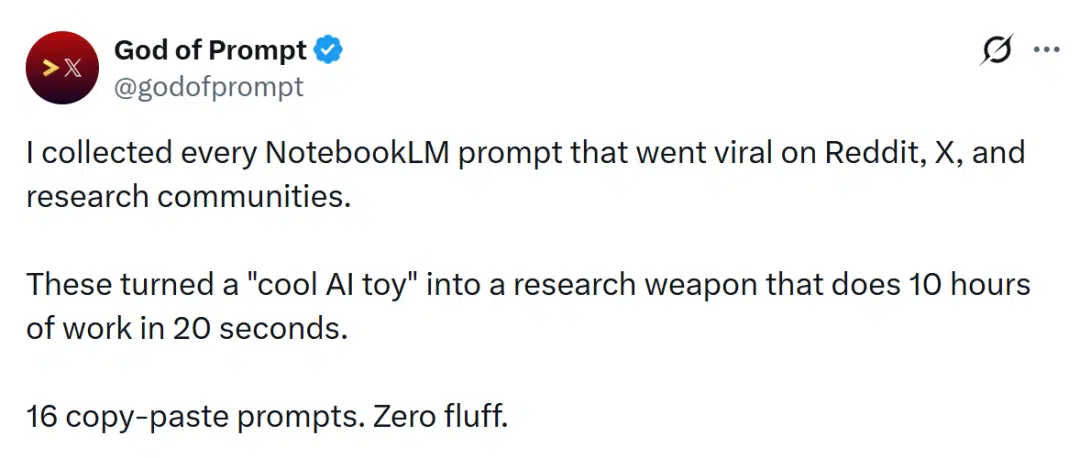
1.「5个核心问题」提示词
此提示词能使AI生成符合教学逻辑的深度问题,而不是停留在表面的内容摘要,从而引导你进行更深层次的思考。
当你需要快速理解一篇长篇文章、一份学术报告或任何陌生文本的核心思想时,它能帮你迅速抓住要点。
"Analyze all inputs and generate 5 essential questions that, when answered, capture the main points and core meaning of all inputs."
2.「课程讲座」终极提示词
"Review all uploaded materials and generate 5 essential questions that capture the core meaning.
Focus on:
- Core topics and definitions
- Key concepts emphasized
- Relationships between concepts
- Practical applications mentioned"
3. 史蒂文·约翰逊的「有趣片段」提示词
"What are the most surprising or interesting pieces of information in these sources? Include key quotes."
4. 带「方向控制」的扩展版本
"I'm interested in writing about [TOPIC].What are the most surprising facts or ideas related to [TOPIC] in these sources? Include key quotes. Focus on [SPECIFIC ASPECT], not [OTHER ASPECTS]."
5. 「智力问答」格式(音频概览)
"A quiz show with two hosts. First host quizzes the second on [TOPIC]. 10 questions total. Mix of multiple choice and True/False.
The host gets answers wrong sometimes. The other corrects with right answers. Share results at the end."
6. 多语言播客技巧
"This is the first international special episode of Deep Dive conducted entirely in [Language].
Special Instructions:
- Only [Language] for entire duration
- No English except to clarify unique terms"
7. 产品经理人格(Google官方)
"Act as a Lead Product Manager reviewing internal documentation. Ruthlessly scan for actionable insights, ignoring fluff.
Synthesize into "Decision Memo" format:
- User Evidence: Direct quotes indicating user problems
- Feasibility Checks: Technical constraints mentioned
- Blind Spots: What's missing from source text
Use bullets. If I ask vague questions, force me to clarify."
8. 科研人员人格(Google官方)
"Act as research assistant for a senior scientist. Tone: strictly objective, formal, precise.
Assume advanced knowledge of [FIELD]. Don't define standard terminology.
Focus on methodology, data integrity, and conflicting evidence.
Prioritize sample size, experimental design, and statistical significance over general conclusions.
Format with bolded sections:
- Key Findings
- Methodological Strengths/Weaknesses
- Contradictions"
9. 初中教师人格(Google官方)
"Act as an engaging Middle School Teacher. Translate source documents into language a 7th grader understands.
Structure every response:
- The "tl;dr": One sentence using simple words
- Analogy: Real-world metaphor for the concept
- Vocab List: 3 difficult words defined simply
For dense paragraphs, break into True or False quiz format."
10. 文献综述主题提取提示词
"From papers on [TOPIC], identify 5-10 most recurring themes.
For each theme provide:
1. Short definition in your own words
2. Which papers mention it (with citations)
3. One sentence on how it's treated (debated, assumed, tested)
Present as structured table."
11. 寻找矛盾的提示词
"From papers on [TOPIC], identify major contradictions or conflicting findings.
For each contradiction provide:
1. Specific claim from each side (quoted with citations)
2. Possible reasons for disagreement (method, sample, context)
3. What evidence would resolve the conflict"
12. 基于来源的差距分析
"Analyze this attempt against my uploaded materials:
Project: [WHAT I TRIED]
My approach: [STEPS I TOOK]
Result: [WHAT HAPPENED]
Expected: [WHAT SHOULD HAVE HAPPENED]
Cross-reference with sources:
- Quote methodologies I didn't follow
- Identify concepts I missed entirely
- Find prerequisites I skipped
Output: "Gap in [concept]: You missed [step], but [Source, Page X] states: '[quote]'""
13. 概念执行提示词
"Help me implement the concept of [TOPIC].
For each relevant source:
1. Quote key evidence
2. Connect it to other retrieved information
3. Note conflicting viewpoints
4. Provide a clear action to take
Synthesize into ordered action list with thorough, actionable steps.
Ground all points in specific quotes. Acknowledge knowledge gaps."
14. 概念综合提示词
"Synthesize the connection, however abstract, between [TOPIC1] and [TOPIC2].
For each relevant source:
1. Quote key evidence
2. Connect to other retrieved information
3. Note conflicting viewpoints
4. Note interesting combinations
Synthesize into clear summary focusing on connections.
Ground all points in quotes. Acknowledge gaps."
15. 全面主题分析
"Provide accurate, well-reasoned information about [TOPIC].
Planning:
- Essential aspects to explore?
- Key questions to answer?
- Existing debates or controversies?
Structure:
OVERVIEW: Summary, major concepts, current relevance
ANALYSIS: Evidence-supported discussion, examples, limitations
SOURCES: Key sources, conflicts, confidence levels
Standards:
- Separate facts from interpretations
- Support claims with evidence
- Maintain objectivity"
16. 辩论格式提示词
"Generate a debate between two hosts with opposing viewpoints on [TOPIC].
Host 1 argues for [POSITION A].
Host 2 argues for [POSITION B].
They should challenge each other's points, cite specific evidence from sources, and let the listener decide who made the stronger case."
写在最后

<
© 版权声明
文章版权归作者所有,未经允许请勿转载。
相关文章


评论已关闭...

这提示词合集太硬核了,直接抄作业了👍
之前试过类似的方法,结果AI光说不练,这次能落地吗?
“无情地扫描可执行洞察”——这产品经理人设有意思啊😂
第9条让AI当初中老师,我家娃作业有救了hhh
“太长不看版”加类比,这不就是我想要的懒人包!
那个啥,多语言播客功能,能用来练英语听力不?
史蒂文·约翰逊那个“有趣片段”提示词,感觉挖坑专用
我用过类似的,但AI总自己编引用,咋办?
“寻找矛盾”这条,适合怼那些自相矛盾的论文666
之前搞研究最怕文献综述,现在能靠表格偷懒了
第12条差距分析,简直是复盘神器,踩过太多坑了
“辩论格式”提示词听着新鲜,但AI能真打出火药味?
感觉还行,就是不知道在国产模型上能不能跑
这年头不会写prompt,是不是就跟文盲差不多了…